Department: Department of Swasthavritta evum Yoga
Course: 2nd Professional BAMS
Subject: Swasthavritta (Community Health & Preventive Medicine)
1. Administrative Overview
| Parameter | Details |
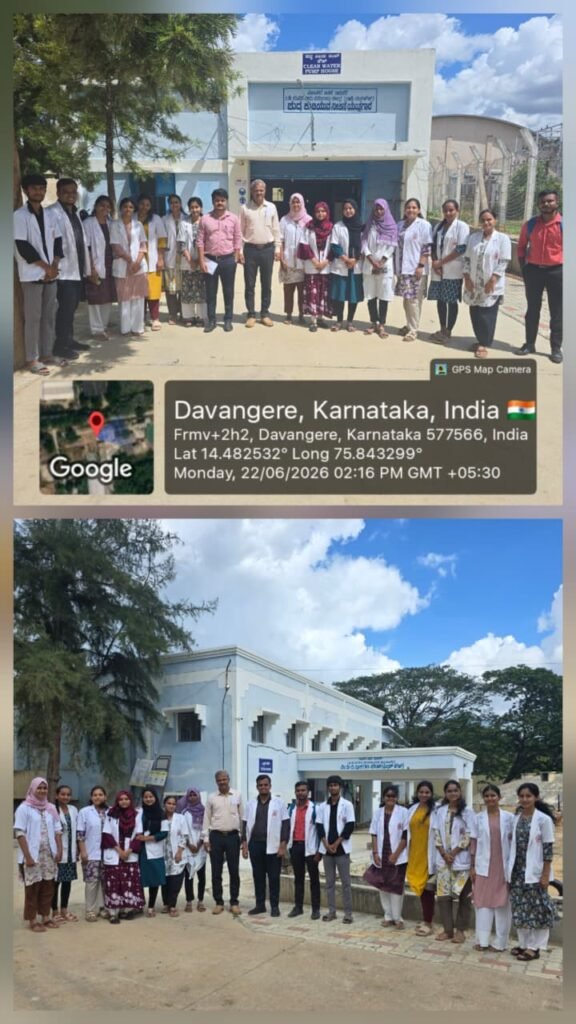
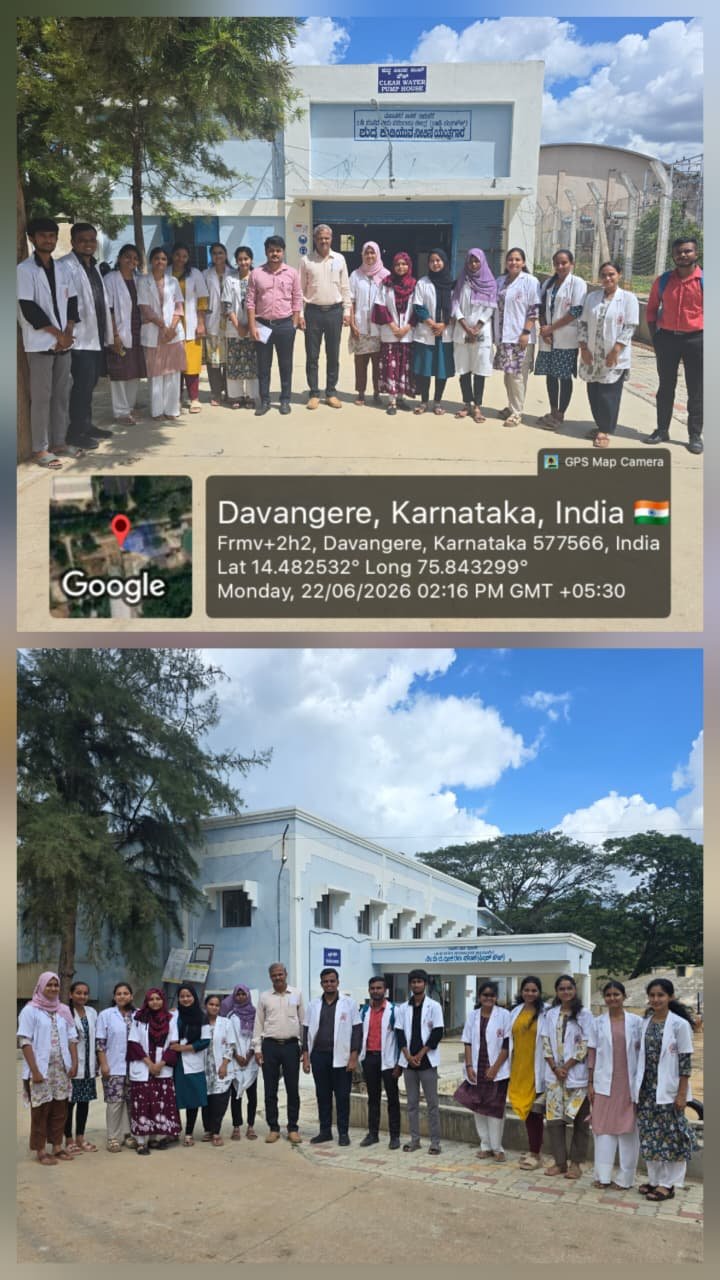
| Date of Visit | 22-06-2026 |
| Name & Location of Plant | Bathi Pump House, Neelanahalli |
| Total Number of Students | 30 Students |
| Accompanying Faculty | Dr Sunil H |
| Plant Guide / Technical Expert | Veeresh |
2. Introduction & Curricular Objectives
In Ayurveda, water (Jala) is recognized as one of the Pancha Mahabhuta (five core elements) and an essential Upastambha (supporting pillar) of life. The classical texts warn that vitiation of water (Jala Dushti) is a primary factor in Janapadodhwamsa (epidemics/community-wide destruction).
The Department of Swasthavritta organized this field visit to bridge classical principles of Jala Shodhana (water purification) with modern, large-scale public health engineering practices.
Key Learning Objectives:
- Understand the mechanics of modern large-scale water purification.
- Relate modern parameters of pure water with Ayurvedic concepts of Shuddha Jala (pure, potable water).
- Observe community health measures implemented to prevent water-borne diseases (Jalaja Roga).
3. Technical Observations: The Purification Sequence
The plant operators guided the students sequentially through the stages of large-scale purification. The observed steps are detailed below:
1.Screening and Aeration:Step 1: Raw Intake.
Raw water drawn from the source [Insert Source, e.g., River/Reservoir] passes through physical screens to remove large floating debris. It is then subjected to Cascade Aeration, which exposes the water to atmospheric oxygen. This process removes volatile gases (like hydrogen sulfide), neutralizes bad odors, and oxidizes dissolved iron and manganese.
2.Coagulation & Flash Mixing:Step 2: Chemical Dosing.
Chemical coagulants, primarily Alum (Sphatika), are added to the water. The water enters a flash mixer where it is violently agitated for a few minutes. This rapidly disperses the alum throughout the bulk water, neutralizing the negative electrical charges on suspended clay and organic particles.
3.Flocculation & Sedimentation:Step 3: Particle Settling.
The water flows into a clariflocculator where gentle, slow mixing allows neutralized particles to collide and clump together into larger, heavy masses called flocs. The water then moves to the sedimentation tanks, where it is detained for 2 to 4 hours. Under gravity, 90–95% of the heavy flocs settle to the bottom as sludge.
4.Filtration:Step 4: Media Beds.
The clarified water passes through Rapid Sand Filters. These filter units consist of graded layers of fine sand, coarse sand, gravel, and pebbles. This physical barrier traps remaining microscopic particulate matter, algae, and a significant portion of bacteria, yielding crystal-clear water.
5.Disinfection:Step 5: Pathogen Elimination.
To ensure microbiological safety, Chlorination is performed. Chlorine gas or bleaching powder is injected into the water, maintaining a contact time of at least 30 minutes. This eliminates remaining pathogenic bacteria and viruses. The plant maintains a residual chlorine level of 0.2 to 0.5 mg/L to prevent re-contamination during pipeline distribution.
4. Quality Control & Monitoring Standards
The plant features an integrated testing laboratory to monitor physical, chemical, and biological parameters. The technical staff demonstrated how they track safety metrics before releasing water into public municipal lines:
- Turbidity: Maintained at less than 1 NTU.
- pH Levels: Regularly monitored to fall within the safe, slightly alkaline range of 6.5 to 8.5.
- Residual Chlorine: Tested using the Orthotolidine (OT) test to ensure continuous disinfection capacity.
- Microbiological Check: Periodic membrane filtration tests to ensure zero E. coli or coliform colonies per 100 ml of water.
5. Ayurvedic Integrative Analysis (Swasthavritta Perspective)
During the visit, students applied a comparative lens to match modern municipal steps with traditional classical text references:
| Modern Purification Stage | Ayurvedic Concept / Equivalent | Textual Reference / Clinical Significance |
| Aeration & Solar Exposure | Suryaatapa / Pavana Sevana | Sushruta Samhita states that exposing water to sunlight and wind neutralizes microbial heaviness (Gurutva). |
| Alum Coagulation | Sphatika Shodhana | Nighantus mention Sphatika (Alum) as a Prasadhana Churna (precipitating agent) to clear muddy water. |
| Sand Filtration | Vastra-Nishyandana / Saandrakatva | Use of physical filtration mediums (cloth, clean sand layers) to pull out Pankaja (muddy) particles. |
| Residual Chlorine Safety | Krimi-Ghna Measures | Destroys unseen disease-causing factors (Adrushya Krimi), preventing waterborne outbreaks (Janapadodhwamsa). |
6. Educational Takeaway & Conclusion
This field visit provided 2nd-year BAMS students with concrete practical insights into community-wide preventive health infrastructure. Observing modern water treatment highlighted the scale required to implement public health objectives that parallel classical concepts of maintaining Jala Shuddhi (water purity).
The visit successfully demonstrated that safe, potable (Paniya) and palatable (Hrudya) water is the baseline requirement for maintaining community health, preventing waterborne epidemics, and upholding the core values of Swasthavritta.
Report Prepared By:
Department of Swasthavritta evum Yoga
[AEA’s AShwini Ayurvedic College And PG Centre Davanagere]