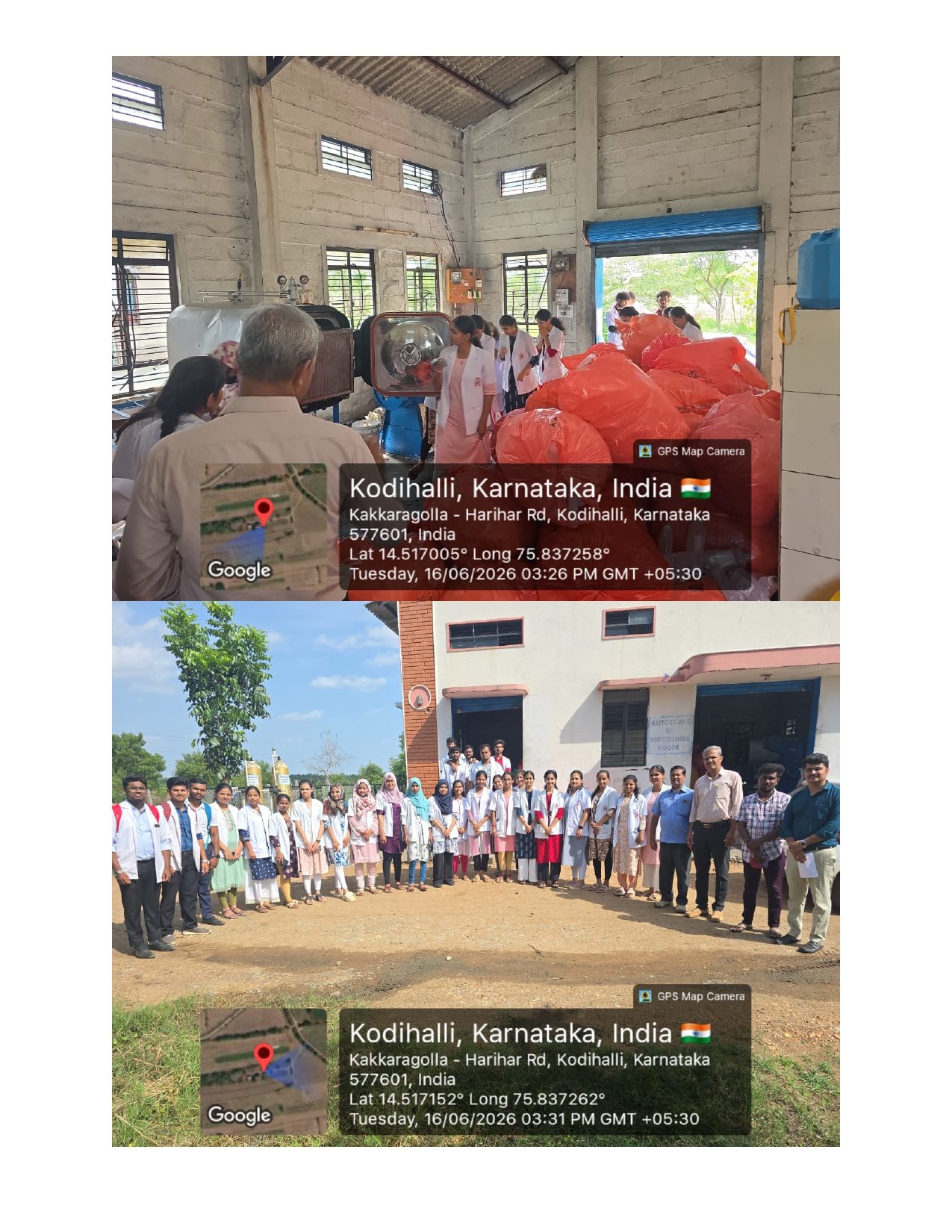
Host Institution: M/s Sushanth Environmental Technologies (Common Bio-Medical Waste Treatment Facility - CBMWTF), Sy. No. 24/2, Amaravathi Colony, Kodihalli Road, Harihar Taluk, Davanagere, Karnataka
Organizing Institution: Ashwini Educational Association’s Ayurveda Medical College and P.G. Centre, Davanagere
Organizing Department: Department of Swasthavritta & Yoga
Target Audience: 2nd Year B.A.M.S. Students
Date of Visit: June 16, 2026
1. Introduction & Objectives
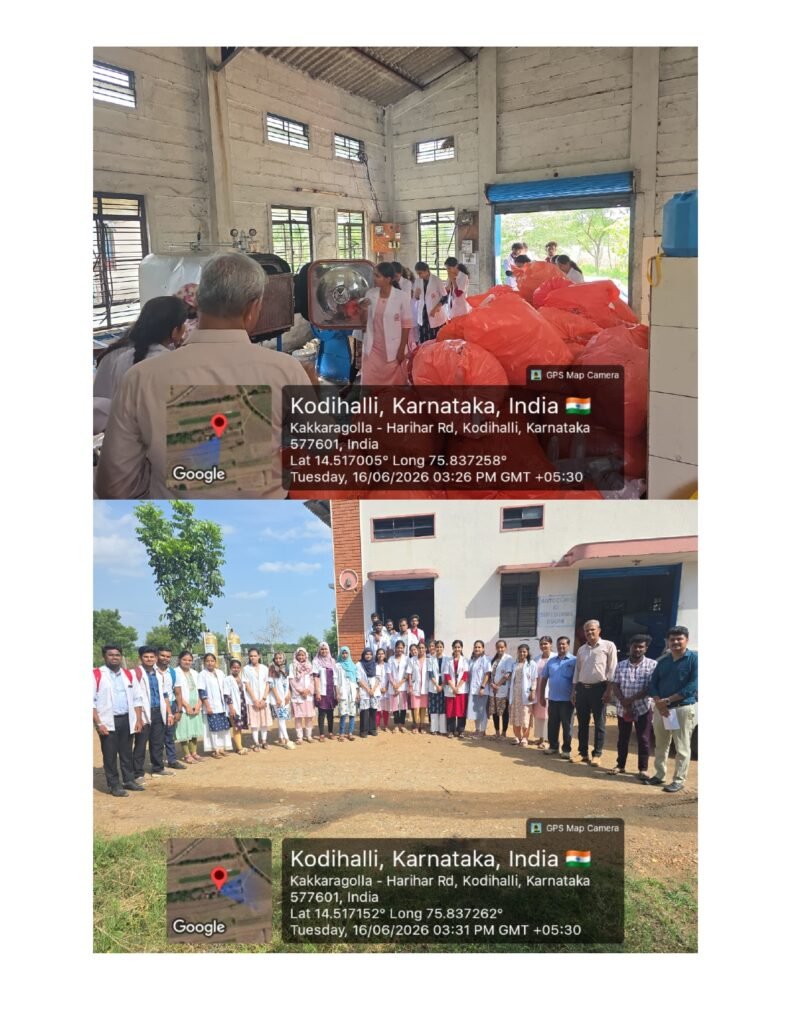
Managing healthcare waste safely is a foundational pillar of public health and environmental sanitization. As part of their practical curriculum in Swasthavritta (Preventive and Social Medicine), the 2nd-year B.A.M.S. students visited M/s Sushanth Environmental Technologies today.
As an authorized Common Bio-Medical Waste Treatment Facility (CBMWTF), this plant acts as a centralized node for collecting, transporting, treating, and safely disposing of hazardous biomedical waste generated across the regional healthcare ecosystem.
Key Objectives:
- To study the live operational mechanics of a centralized bio-medical waste treatment plant.
- To understand color-coded segregation, barcoding, and safe transport protocols in alignment with the Bio-Medical Waste Management Rules.
- To observe heavy industrial sterilization equipment including high-temperature incinerators, autoclaves, and shredders.
- To contextualize the management of Visha (toxic/hazardous materials) and Malas (waste products) with modern ecological and community health guardrails.
2. On-Site Observations & Core Processing Units
The facility managers guided the students through the strict zoning laws of the plant, tracking the chronological movement of healthcare waste from receipt to final elimination.
A. Reception & Barcode Screening
Biomedical waste arrives in dedicated, puncture-proof, leak-proof transport vehicles. Students observed how waste bags are electronically scanned using a barcoding system to track data (origin hospital, weight, and waste category) before moving to processing. This step ensures strict institutional accountability.
B. The Color-Coded Segregation & Treatment Pipeline
The facility demonstrated how different waste streams are treated based on India's national bio-medical waste guidelines:
| Waste Category | Container Type | Observed Treatment Method on Site |
| Yellow Bag (Anatomical, soiled, chemical, expired medicines, microbes) | Non-chlorinated plastic bags | Incineration: Handled via a high-temperature twin-chamber incinerator ($850^\circ\text{C}$ in primary / $1050^\circ\text{C}$ in secondary chamber) to ensure complete thermal destruction and zero harmful emissions. |
| Red Bag (Contaminated recyclable plastics, tubings, bottles, syringes without needles) | Puncture-proof containers/bags | Autoclaving & Shredding: Subjected to high-pressure steam sterilization to kill pathogens, then fed into a mechanical shredder to prevent illegal plastic reuse. |
| White Cardboard / Translucent (Sharps, needles, blades, scalpels) | Rigid, puncture-proof, leak-proof container | Dry Heat Sterilization/Shredding: Completely mutilated and treated to eliminate any physical or biological hazard. |
| Blue Box (Glassware, metallic body implants) | Puncture-resistant cardboard box | Chemical Disinfection / Hydroclaving: Cleaned, disinfected, and sent for authorized industrial recycling. |
C. Air Pollution Control Devices (APCD)
A significant learning point for the students was checking the plant's massive wet scrubbers, acoustic enclosures, and high-velocity stacks. The engineering team explained how these systems neutralize toxic gases like dioxins and furans before cleaner air is released into the atmosphere, ensuring local air quality stays safe.
3. Ayurvedic Integration & Swasthavritta Perspective
The faculty from the Department of Swasthavritta bridged these heavy industrial methods back to fundamental Ayurvedic principles:
- Janapadodhwansa Prashamana (Preventing Epidemics): Classical texts dictate that air, water, and land contamination are the root causes of community-wide epidemics (Janapadodhwansa). Efficient, centralized thermal destruction of biological pathogens is a modern implementation of preserving Vayu (air), Jala (water), and Desha (land) purity.
- Concepts of Dhupana (Fumigation/Sterilization): Modern autoclaving and incineration are technological advancements of Dhupana Karma—the classical Ayurvedic method of using controlled heat and anti-microbial vapors to sterilize clinical environments, labor rooms, and surgical items.
- Eco-Ethical Duties of a Physician: In ancient text frameworks, a healer's duty expands beyond the individual patient to the safety of the entire settlement (Grama/Nagara). Understanding where clinical waste goes instills an eco-ethical mindset in future Vaidyas regarding how they run their clinics and hospitals.
4. Conclusion & Acknowledgments
The industrial exposure gave the 2nd-year B.A.M.S. batch a transparent view of the hidden logistics that keep public health functional and keep epidemics at bay. Seeing the processing of hazardous waste firsthand emphasized that public health relies just as much on proper waste disposal as it does on clinical treatment.
The Department of Swasthavritta & Yoga extends its deep gratitude to the executives and field engineering staff at M/s Sushanth Environmental Technologies, Harihar, for taking the time to explain these systems, and thanks the institutional leadership of Ashwini Educational Association for sponsoring this public health field excursion.
Report Compiled By:
Department of Swasthavritta & Yoga
Ashwini Educational Association’s Ayurveda Medical College and P.G. Centre, Davanagere